Showing posts with label Texas. Show all posts

Thursday, September 5, 2013

Long Road to Texas Independence

The Eagle shows the territory of US in 1833,
after the Adams-Onis Treaty
In 1819, the United States formally abandoned any claim to the territory of Texas through the Adams-Onis Treaty.  That treaty upset many US citizens in Louisiana and Mississippi who believed that the territory conveyed in the Louisiana Purchase (1803) include parts of East Texas.  James Long of Natchez,  Mississippi was particularly pissed.  In June of 1819, Long and Eli Harris led an "expedition" to Nacogdoches, New Spain. Thanks to the fact that rapid mass troop transport had not yet been invented, Long and Harris successfully established the first (?) Republic of Texas. On the noble side of the revolution, the citizens of the Long Republic promoted religious freedom, tolerance and freedom of the press. On the more traditional side of revolutions, each member of the "expedition" received 10 acres of land for their sacrifice.  Long attempted to enlist the assistance of pirate Jean Lafitte, promising to appointment Lafitte governor of Galveston.  What did Long learn?  Don't trust pirates.  After accepting the governorship, Lafitte "traded" the information about Long's revolution to the Spanish who had not yet realized that a small portion of the empire had been usurped.  Shortly thereafter, 500 Spanish troops arrived at Galveston and drove Long and his expedition back to Louisiana.  The Long Republic lasted four months.  The flag of the Long Republic was red with a single white star in the middle.

Wednesday, September 4, 2013

Fredonia or Petoria: The Flag Makes the Nation

Flag of Fredonia 1825-1826
In April of 1825, Hayden Edwards received a grant from the districts of Texas and Coahuila (districts of Mexico) to colonize the area of Nacogdoches with 800 families.  Edwards began to promote and organize the colony with his brother B. W. Edwards.  As a condition of the grant, Edwards had to honor any prior grants of land in his settlement territory.  This led to a vetting of prior settlers in the area to determine who had a legitimate land claim, a contentious process which sparked a feud between Edwards and the Mexican government. Those who lost their land appealed to the regional Mexican authorities.  Empresario Stephen F. Austin attempted to quench the rebellious tendencies of Hayden Edwards. In a letter to Edwards, Austin wrote, "The truth is, you do not understand the nature of the authority with which you are vested by the government, and it is my candid opinion that a continuance of the imprudent course you have commenced will totally ruin you, and materially injure all the new settlements." The truth was that Edwards envied and despised Austin. So, being told by Austin that he should know his place probably pushed Edwards to secede from Mexico. The irony of this is that Austin would eventually mount his own rebellion, successfully establishing the Republic of Texas. In preparation for the secession, Hayden signed a treaty with the local Cherokee Indians (represented by the red band in the flag) and declared independence from Mexico on December 21, 1826. Assisted by Stephen F. Austin (and the Cherokee Indians), the Mexican government forcibly suppressed the rebellion, which ended on January 31, 1827. (more info on Fredonia) After fleeing to Louisiana, Hayden Edwards returned to Texas during the Texas Revolution and settled in Nacogdoches. Hayden Edwards died within the territory of his colony in 1849.
Flag of Petoria
.

Tuesday, September 3, 2013

Nacogdoches: Old Town with Deep Roots in Texas

1885 picture of the Old Stone Fort in Nacogdoches
In the summer of 1779, Spain designated the community around the mission of Nuestra Senora de Guadalupe de los Nacogdoches a "pueblo."  Older than the six flags of Texas, the town of Nacogdoches claims that it has flown flags of nine nationalities: Spain, France, Mexico, Republic of Texas, United States, Confederate States, and the forgotten Magee-Gutierrez Republic, Long Republic, and the Fredonian Republic.

Friday, August 30, 2013

Anniversary of the Confirmation of Thurgood Marshall to SCOTUS

Telegram from Martin Luther King, Jr. to Thurgood Marshall, June 13, 1967.
On June 12, 1967, Justice Tom C.Clark (native Texan and graduate of the law school at University of Texas) announced his retirement from the United States Supreme Court.  Earlier in the year, President Lyndon B. Johnson (also a native of Texas) appointed Justice Clark's son, Ramsey Clark, to serve as Attorney General. The potential father - son / judicial branch - executive branch conflict prompted Justice Clark to step down from the bench.  On the way down, Justice Clark enthusiastically advocated for the appointment of Thurgood Marshall, then solicitor general, as his replacement.  As retold by President Johnson, Justice Clark predicted that "the President would appoint someone who will fill my shoes to overflowing and possibly break them open."  After an unusually long delay (although not by today's standards), the Senate confirmed the appointment with a vote of 69 to 11.


Friday, January 13, 2012

Goodbye to the Rodeo Prison: "The Wildest Show Behind Bars"

The Mad Cow Scramble at the Texas Prison Rodeo
The Texas Prison Rodeo started in 1931 at the Huntsville State Prison.  In addition to the standard rodeo events, the Prison Rodeo included wild cow milking and bull dogging.  One of the most popular events was "Hard Money."  A sack of money was tied to the horns of a wild (and angry) bull.  Forty inmates were then placed in the ring with the bull and told "go get it."

The Texas Prison Rodeo ended in 1986.  With the demolition of the arena last week, story of the Texas Prison Rodeo has ended.

Sunday, January 8, 2012

Mysteries of La Belle: Roman Coin, Figa, and French ownership

La Belle hull in situ.
La Belle was a small French ship that sank off the coast of Texas in 1687.  The location of the wreck was mapped by the Spanish in 1689.  The ship sank in Matagorda Bay, just North of the barrier island protecting the bay.  For the next 300 years, the ship lay undisturbed in the sandy bed of the bay.  In 1995, archaeologists with the Texas Historic Commission located La Belle and began the arduous task of excavating the sunken and silted wreck.  (link to an Internet tour of the La Belle)

Intermixed with the detritus of the 17th century wreck was a Roman denarius dating to 69 A.D.  Hmm.  Strange.  If not evidence of time travelers or Atlantis, this odd artifact shows that humans have always been fascinated with history.  A sailor must travel light, thus a small silver coin tucked in one's pocket might be a perfect memory of home.  Perhaps the forgotten sailor picked the coin as a child working the fields of his childhood home France.  The discovery of the coin may have been a longed for omen telling him to leave the hills of France and seek work in the dockyards.

1689 Spanish Map.
Another talisman discovered in the wreck was a glass figa.  Such an object might have been carried as a protective charm, warding off evil.

Glass figa.
Despite resting in the territorial waters of Texas (U.S.) since the beginning of its nationhood, the French government immediately claimed ownership of La Belle and the ship's content.  An agreement was reached that the U.S. would have the right of possession of the ship and all within, but the French government would be recognized as the owner.  Despite this arrangement (or because of it), the skeleton of a crew member discovered in the forward hold was buried in Austin.

Tuesday, December 20, 2011

Unnamed Man Ok after bender 123 years ago

The Waco Evening News reported today (December 20), 123 years ago (1888), that the "unfortunate man" who had succumbed to mania a potu is feeling much better.

In other news:
- The Constable waited until after the wedding ceremony to arrest another unnamed man for swindling and child abuse. 
- Lizzie Bennet was tried and convicted of swearing in a public place.  Fine of $5.00.

Monday, December 19, 2011

Mania a Potu: Near death in Waco 1888

On page 4 of the Waco Evening News this day, 123 years ago, a curious note was placed regarding an incident at the saloon.  Unfortunately, inside jokes are lost in time.  Who was the traveler so "well known in Waco" that a name was unnecessary?

"The banks of the dark river were pressed mighty close to-day, by the staggering feet of a commercial traveler, well known in Waco.  He fell from a chair in a saloon about ten oclock this morning, and was taken to the city hall.  His symptoms verging on a fierce form of mania a potu, grew alarming and a physician was called in.  At three this evening he was thought to be out of danger, but if he should recover he will have made a narrow escape from the dark waters of the Styx."

"Mania a potu" - madness from excessive consumption of alcohol.

Lost & Found in Waco: 123 years ago

12/19/1888 - Waco Evening News
The Waco Evening News, in service to the citizens of Waco, Texas, provided a daily list of notices regarding items lost and found.  On this day (December 19), 123 years ago, the News included the following notices:
Sanborn Map, 1885, McLelland Opera House
- Lost - Memorandum book of the Waco Bridge Co.  Lost on Austin Ave.  Please return to Mr. Russell at the bridge.  (The Bridge Co. was the entity that collected tolls for crossing the famous Waco Suspension Bridge.)
- Found - A copy of "Daniel's Chancery Pleading and Practice" on south 5th Street.  (hmm, heavy book to drop.  I guess he running late to a hearing at the courthouse.  In 1888, McLennan County was on its third courthouse, which was located at the corner of Franklin Ave. and 2nd Street.)
- Lost - A pair of gold spectacles.
- Found - A boy's overcoat, at the old McClelland opera house.

- Lost - One blow Pigeon.  $1 reward.  (I have no idea what a "blow pigeon" is.)
Sanborn Map, 1885, McLennan Courthouse

Monday, March 28, 2011

Salado Wine Festival
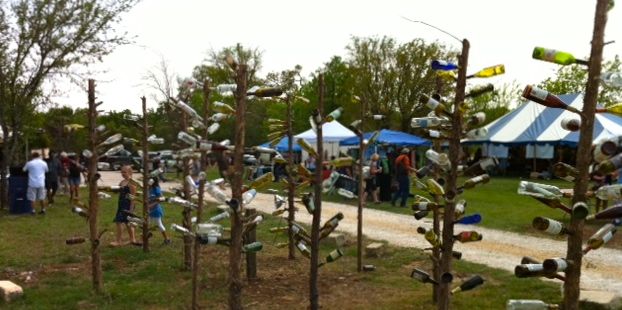
I made two unexpected discoveries this weekend.  First discovery was the The Salado Texas Wine & Rouge Art Festival.  Salado has grown in popularity among those who like rustic Texas kitsch and bead making.  In addition, there are some fine antique shops.  Salado has also developed a reputation for wine tasting... fermented grapes help make cast-plastic garden rabbits irresistible.  Joking aside, the Wine Festival was simple and successful.  Twenty vineyards participated.  For $10 you get a wine glass and tickets to taste six wines.  The second discovery was that Texas vineyards are putting out some excellent wines.  My favorite was the McPherson Viognier.

Saturday, February 26, 2011

Oldest Map of Texas

1519 map of the Gulf of Mexico by Alonzo Alvarez de Pineda
The "of Texas" may be a misnomer, but this Spanish map from 1519 is considered, by trusted authorities (Wikipedia see earlier post), to be the oldest map of Texas.  In 1519, Alonzo Alvarez de Pineda led an expedition to find a sea passage from the gulf of Mexico to the Bay of Asia (also called the Pacific Ocean).  The academic legacy of de Pineda has been a series of papers arguing over what rivers he visited.  The problem is not with the rivers, but the fact that each explorer who would pass the river would give it a new name in the glory of God and the patrons who funded their explorations.  The re-naming problem is made worse by the lousy maps drawn de Pineda and his cohorts.  For example, is "Espiritu Santo" the Mississippi or the Alabama River?  Is "Rio de las Palmas," to which he referred in his journal, actually the Rio Grande (aka Rio soto la Marina, aka Rio Bravo del Norte, aka Rio Bravo) or the Rio Panuco?  Ultimately, modern scholars (should) have concluded that he really did not know where he was, because he was relying on directions from native Americans and his main competition, Hernan Cortes.  And, we all know what a trickster that Cortez guy was... all except the Aztecs and de Pineda.

Wednesday, February 16, 2011

Texas on the Edge

Speaking of lists, the Texas on the Brink report came out on the 13th of this month.  The report lists how Texas ranks among all 50 states on a number of socio-economic topics.  For example:

Percent of population 25 and older with a high school diploma. = 50th
Birth rate. = 2nd
Teenage birth rate. = 7th (I am amazed that anyone was born as a teenager, but numbers do not lie.)
Percent of uninsured children. = 1st
Percent of children living in poverty. = 4th
Percent of population uninsured. = 1st
Per capita spending on mental health. = 50th
Average credit score. = 49th
Workers compensation coverage. = 50th
Executions. = 1st
Violent crime rate. = 16th