Showing posts with label SCOTUS. Show all posts

Monday, March 26, 2012

Chaucer and the U.S. Supreme Court: I know it when I hear it

George Carlin - 1978 - 7 Filthy Words
As one can guess, all references to Chaucer by the United States Supreme Court have concerned the issue of obscenity.

United States v. 12 200-ft. Reels of Super 8MM. Film, 413 US 123 (1973) - In this case, the Court considered the issue of whether a person could import obscene material for personal use.  The dissent makes reference to the ribald character of the Canterbury Tales.  The dissent explains that it is impossible to define "obscenity" because it is ever shifting and highly subjective.  For example, Chaucer was morally offensive to Victorian England, now it is required reading in US high schools... just don't let them read the "Miller's Tale."

FCC v. Pacifica Foundation, 438 US 726 (1978) -  This is the landmark case addressing George Carlin's "7 Filthy Words" monologue that was aired in 1973. The dissent cites to Chaucer's Canterbury Tales as an example of literature that could not be read, un-edited, on the radio under the current FCC rules concerning obscenity.

FCC v. Fox Television Stations, Inc., 129 S. Ct. 1800 (2009) - The case discusses the FCC fines for cussing on a live television broadcast.
"This case concerns utterances in two live broadcasts aired by Fox Television Stations, Inc., and its affiliates prior to the Commission's Golden Globes Order. The first occurred during the 2002 Billboard Music Awards, when the singer Cher exclaimed, "I've also had critics for the last 40 years saying that I was on my way out every year. Right. So f* * * `em." Brief for Petitioners 9. The second involved a segment of the 2003 Billboard Music Awards, during the presentation of an award by Nicole Richie and Paris Hilton, principals in a Fox television series called "The Simple Life." Ms. Hilton began their interchange by reminding Ms. Richie to "watch the bad language," but Ms. Richie proceeded to ask the audience, "Why do they even call it `The Simple Life?' Have you ever tried to get cow s* * * out of a Prada purse? It's not so f* * *ing simple." Id., at 9-10. Following each of these broadcasts, the Commission received numerous complaints from parents whose children were exposed to the language."
The Court goes on to explain that a case by case analysis is appropriate.  For example, what and when an expletive is said makes a difference.  Children would not be watching a live production of the Miller's Tale, and if they did, they would be cussing their parents for control of the remote control.  [Note: this my be an inaccurate interpretation of the opinion.]

Wednesday, March 21, 2012

70th Anniversary of the Act of March 21, 1942: Criminalized Being a Japanese American

Gordon Hirabayashi, 1945
The forced interment of Japanese Americans during WWII is a sad, dark shadow on American History.  By Executive Order 9066, President Franklin Roosevelt authorized the Secretary of War to designate "military areas" within the US from where US citizens and residents (of Japanese ancestry) may be excluded.  The Legislative Act of March 21, 1942 (Public Law 503) ratified the the president's order and made it a criminal offense to defy that order.

The law went into effect immediately; the judicial review of the law took some time.  The first Supreme Court case to review the constitutionality of Executive Order 9066 and the Act of March 21, 1942 was Hirabayashi v. US, 320 U.S. 81 (1943).  A senior at the University of Washington, Mr. Hirabayashi was charged with two crimes: failing to remain within the designated military area after curfew and failing to report to the Civil Control Station.  Mr. Hirabayashi challenged his conviction on the grounds that the laws unconstitutionally discriminated against US citizens of Japanese descent.  Mr. Hirabayashi was born in the US and had never traveled to Japan. 

The Supreme Court acknowledged that race is, most of the time, irrelevant and that discrimination based on race is, most of the time, prohibited.  But, the Court said that when dealing "with the perils of war," race may be relevant for acts taken in the interest of national defense or the "successful prosecution of war."  In support of their conclusion, Justice Stone quoted Justice Marshall in the landmark decision of McCulloch v. Maryland.  "We must never forget, that it is a constitution we are expounding," "a constitution intended to endure for ages to come, and, consequently, to be adapted to various crises of human affairs."  The "crisis of human affairs" in McCulloch was the creation of a national bank system. The McCulloch decision firmly established the supremacy of federal law over state law, reasoning that the authority of the US Constitution derives directly from the people and not from the states.  The effect of McCulloch was to extend the authority of the US government beyond specifically enumerated powers.  The authority to create a national bank may not be expressly created by the Constitution, but that authority is granted between the lines by the "necessary and proper" clause.  The Legislature has the power to create "all laws" which are necessary and proper for executing the express powers vested by the Constitution.

It is easy to look back and criticize an opinion forged in throws of world war, but when a nation needed calm sobriety, the Judiciary failed its citizens.  In light of McCulloch, the 1942 Court should have asked "Did the people of the United States grant the federal government the power to detain its citizens based on race without due process of law?"  "Various crises of human affairs" cannot be a justification and judicial tool for abrogating citizen's freedoms.  What we learn from Justice Marshall in the McCulloch case is that an analysis of constitutional power begins with the citizens of the nation who relinquished their autonomy "to form a more perfect union, establish justice, insure domestic tranquility, and secure the blessings of liberty to themselves and to their posterity."

Friday, December 16, 2011

122nd Anniversary of Hume v. United States (132 US 406): origin of phrase "Aw Shucks"

 Government Hospital for the Insane, founded 1852
In 1883, the Government Hospital for the Insane (National Insane Asylum) in Washington (later to be known as St. Elizabeth's) had a desperate need for 8,000 pounds of shucks.  Frank Hume, a supplier of goods, responded to the U.S. government's call for bids.  Mr. Hume bid 60 cents per pound for shucks, which the Secretary of the Interior accepted.  It is important to note that at that time, unhackled shucks were worth $12/ton and hackled shucks went for $35/ton.  Per pound that is .6 cents and 1.75 cents.  The Court of Claims found the contract to be a grossly unfair and thus an unconscionable contract.  Oh Frank Hume, you were such an "equity rouge."  But how could the Secretary of the Interior be such a "common-law fool" as to math?  The Court of Claims suggested that the bid sheet was misprinted and instead of "pounds," it should have read "100 pounds."  Anyway, the Court of Claims disregarded the contract, following the precedent set in the famous "equity rouge" case of James v. Morgan, 1 Lev. 111 (1663). Morgan, like the U.S. Secretary of Interior, agreed to buy a horse for a barley of corn for each nail in the horse's shoe, doubling the price for each nail.  This convoluted calculation (similar to car lease agreements) resulted in a price 12.5 times the market value of the horse.  Thus was born the common law principle that gross mathematical ignorance is a defense to contracts. As applied by the Court of Claims, Mr. Hume was only entitled to the market value of his shucks (thus the phrase "Aw Shucks" was born): $117.60 ($35/ton).

Both the United States and Frank Hume filed a petition for review to the U.S. Supreme Court.  Hume v. United States, 132 U.S. 406 (1889).  In a tradition of government contract shenanigans, Mr. Hume argued that he fully intended to bid .60 cents per pound, an amount 35 times the market value of the shucks actually delivered.  "One day," Mr. Hume argued, "the U.S. government will pay $436 for a hammer and $640 for a toilet seat, whatever that is.  My attempt to defraud the government should be judged in light of future fiscal failings by Washington."  In response, Asst. A.G. Maury stated that, "The time is now that you [Legislators of the Bench] create an escape door for the mathematically-challenged of the world to unshackle themselves from contracts that they did not understand in the first place.  Our complete and utter ignorance should void the contract and protect us from having to pay anything for these shucks.  Furthermore, Mr. Hume should be punished for allowing the us to enter into this contract without comprehending how much the contract will cost."

The Supreme Court, with the wisdom of Solomon, returned to nail-counting case of James v. Morgan and affirmed the general rule that an unconscionable contract is void and an "equity rouge" shall receive no more than market value for his shucks.

Tuesday, December 6, 2011

74th Anniversary of Breedlove v. Suttles (302 U.S. 277): A Missed Opportunity for Justice

In 1937, the Supreme Court of the United States declared that poll taxes, as a prerequisite to voting, to be constitutional.  In Breedlove v. Suttles, 302 U.S. 277, (1937), Breedlove, a 28 year old white male, asked the Court strike Georgia's poll tax for violating the Equal Protection Clause of the Federal Constitution.  The Georgia law required a levy against men from the ages of 21-60.  Women were excluded unless they actually registered to vote.  Regarding the equal protection clause, Court promptly retreated to familiar territory: "The equal protection clause does not require absolute equality."  Interestingly, there are no citations for this principal, perhaps its truth is self-evident.  Most cases prior to Breedlove which emphatically stated that equal protection does not require absolute equality concerned equality with regards to taxation.  (See FS Royster Guano Co. v. Virginia, 253 U.S. 412 (1920); Colgate v. Harvey, 296 U.S.404 (1935); Maxwell v. Bugbee, 302 U.S. 277 (1937); Travellers' Ins. Co. v. Connecticut, (1902)).  In Breedlove, the issue of suffrage took a back seat to taxation.

The Court also offered additional arguments in support of Georgia's law.  The reasoning offered by Justice Butler was two-fold.  First, many countries, for a long time, have used poll taxes.  Second, the privilege of voting is not derived from the federal Constitution, but from the State. Thus, poll taxes are a tried and true method of taxation and States have the power to condition the right to vote such that it does not conflict with the 15th and 19th Amendments and "other provisions of the Federal Constitution."

Thirty-two years later, the Supreme Court could no longer ignore the voices of those excluded from the democratic process.  In Harper v. Virgina Board of Elections, 383 U.S. 663, (1966), the Court reversed its decision in Breedlove.

In 1963, the 24th Amendment was ratified making poll taxes in Federal elections unconstitutional.  The Harper decision found poll taxes in both State and Federal elections to be in violation of the Equal Protection clause.

Friday, December 2, 2011

43 Anniversary of Durfee v. Duke, 375 U.S. 106, or " What you can do, we can do better"

Some swamp land is worth fighting for, even across state boundaries.  The dispute begins on the border of Nebraska and Missouri.  The river forms the border.  When the river moves, the border moves.  Durfee filed suit in Nebraska to quiet title, securing her claim through a tax foreclosure deed issued by Nebraska.  Duke claimed her title through a "swamp land patent" from the State of Missouri and through adverse possession.    The Nebraska Supreme Court, surprisingly, found that a Nebraska tax deed trumps a Missouri swamp land patent.  Durfee v. Keiffer, 95 NW 2d 618, (Neb. 1959).

Duke responded by filing suit in Missouri.  The case was removed to Federal Court where it was decided that the land was actually in Missouri, but since the issue of ownership had already been decided by the Nebraska Supreme Court, it could not rule on the issue of ownership.  The Appeals Court disagreed, saying that the issue of ownership could be retried in Missouri because Nebraska never had subject matter jurisdiction: the land was in Missouri.

The U.S. Supreme Court jumped into the fray on the issue of "The Doctrine of Jurisdictional Finality."  Durfee v. Duke, 375 U.S. 106 (1963).  In other words, if you fully and fairly litigate the jurisdictional issues to conclusion, even in a district that does not have jurisdiction, the final ruling will stick.

Wednesday, November 30, 2011

Where is Ai Wei-Wei?

Online.

In support of Ai Wei-Wei, his fans have rallied in a digital protest... in the NUDE.  Ai Wei's photograph, One Tiger, Eight Breasts has been deemed "pornography" by Chinese authorities.  When confronted by the police, Ai Wei said "Nudity is not pornography." 

As acknowledged by Justice Stewart in Jacobellis v. Ohio, 378 U.S. 184 (1964) (concurring opinion), defining pornography is difficult. Mere nudity would be harsh test for pornography since most people, other than some baptists, are born nude.  Some courts have proposed that nudity becomes pornography when it is created with an "intent to arouse."  See U.S. v. One Book Called Ulysses, 72 F.2d 705, 706 (2d Cir. 1934).  That may help a bit, but "intent" and "arousal" are also difficult concepts to define.

i
Manet Olympia (1863)
Titan Venus of Urbino (1583)
Going the other direction on the scale, consider the difference between being "nude" and "naked." This has been fertile dissertation material in the field of art history.  A classic contrast of the nude and the naked is found in the comparison of Titian's Venus of Urbino and Manet's Olympia.  In the juxtaposition of these two images, viewers have found two different modes of representing an unclothed female.  Foucault suggests that the difference arises from the nature of the gaze from and between the subject of the painting and the viewer.

The Day of "Talking Leaves"

On November 28, 1785, the United States and the Cherokee People entered into the aptly titled Treaty of Hopewell.  In exchange for "protection" from the nascent United States, the Cherokee agreed to release prisoners.  The treaty also set the boundary lines between the two nations and acknowledged, indirectly, that each shall have independent jurisdiction over their land.  More out of hope than reality, the treaty concluded with the following proclamation, "The hatchet shall be forever buried, and the peace given by the United States, and friendship re-established between the said states on the one part, and all the Cherokees on the other, shall be universal; and the contracting parties shall use their utmost endeavors to maintain the peace given as aforesaid, and friendship re-established." (see text of treaty)
Historical marker at Hopewell

As many know, "jurisdiction" is a two-edged sword.  Forty-three years later, Georgia passed a series of laws to expel the Cherokee from the "historical boundaries" of Georgia.  In response, the Cherokee Nation filed an original action with the Supreme Court of the United States asking the Court to enjoin the enforcement of Georgia's laws on the grounds that the laws violated the U.S. Constitution and prior treaties, namely Hopewell and Holston. Cherokee Nation v. Georgia, 30 U.S. 1 (1832).
Chief Justice John Marshall

Art. III Sec. II of the U.S. Constitution gives the Supreme Court original jurisdiction over disputes between a state and foreign states.  There lies the rub.  Chief Justice Marshall asked whether the Cherokee Nation is a "foreign state" as the term was used in the "constitution."  The answer...  "No."  The Cherokee Nation, albeit a nation that was foreign, was deemed a different type of entity altogether.  Cherokee Nation v. Georgia declared the Cherokee to be a type of sub-nation, dependent on the United States.  Cherokee, 30 U.S. at 26-27 ("They may more correctly perhaps be denominated domestic dependent nations.").  The Treaty of Hopewell and Holston, despite using the word "treaty" were mere contracts, distinct from a treaty with a proper nation such as France.

As far as the intentions of the framers of the Constitution, Marshall had this to say:
At the time the constitution was framed, the idea of appealing to an American court of justice for an assertion of right or a redress of wrong, had perhaps never entered the mind of an Indian or of his tribe. Their appeal was to the tomahawk, or to the government. This was well understood by the statesmen who framed the constitution of the United States, and might furnish some reason for omitting to enumerate them among the parties who might sue in the courts of the union.  Cherokee, 30 U.S. at 34.

Tuesday, March 29, 2011

To Be or Not To Be Insane?

SCOTUS Mock Trial Mocks Mocking Posner


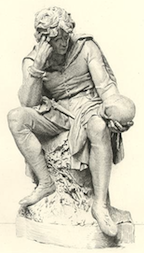
Chief Justice Kennedy sat as judge over a recent mock trial of Hamlet at the University of Southern California.  Hamlet, on trial for murder, sought to hide behind the curtains of an insanity defense.  Apparently two of the twelve jurors bought the "I am but mad north-north-west" line.  But I ask you, could an insane person truly "know a hawk from a handsaw" whether it came by a southerly wind or not?
Alas, poor Rehnquist, I knew him.
A fellow of infinite fairness in
assigning opinions.

Judge Posner of the 7th Circuit Court of Appeals did not take kindly to the literary charades of the Chief Justice.  According to the Wall Street Journal, Judge Posner could be heard muttering to himself, "Seems, Chief Justice!, nay it is.  I know not seems. That's the problem with presidents and Supreme Court justices and billionaires.  They think that because they are successful in one sphere they're experts in everything."

Confronted with the condemnation of Judge Posner, Justice Ruth Gertrude Ginsburg queried, "What have I done, that thou darest wag thy tongue in noise so rude against me? He is an odd person to say that."

Wednesday, March 2, 2011

SCOTUS - Phelps Wins 8-1

It is not a sports score, but it is related to the crude jeering that can be found in a minor league baseball.  The US Supreme Court has affirmed the constitutional right to be a jerk.  In Synder v. Phelps (link to opinion), the High Court ruled that the right to slander the dead, before a funeral, is protected free speech.  Actually, I agree with them.  This was an easy decision.  But, it is sad, very sad, that this ever occurred.  The expressions protected by this opinion are as follows: "Thank God for Dead Soldiers" "You're Going to Hell" etc.
There should the a High Court of Mothers who could say, "We are so disappointed.  I broke my back raising you, and this is all you can do...?"

On the legal issues, this statement from Chief Justice Roberts says it all, "On the facts before us, we cannot react to that pain by punishing the speaker. As a Nation we have chosen a different course—to protect even hurtful speech on public issues to ensure that we do not stifle public debate."

Monday, February 14, 2011

Soul v. Winner = Valentine's Peace


As a sign of love to the world, a group of antiwar protestors (or peace promotors) joined together to form an all-human, all-nude peace symbol on Valentine's Day, 2003.  The spectacle was unspectacular.  Despite the local law prohibiting nudity in the park (minimum requirement of thong and, for women, a bikini top), the police allowed the display, but only behind opaque barriers.  The audacious protestors did leave a mark at the courthouse on, of all things, attorney's fees.  Check out the Supreme Court case of Sole v. Wyner, 127 S. Ct. 2188.


 "But the display was set up outside the barrier, and participants, once disassembled from the peace symbol formation, went into the water in the nude."  Sole v. Wyner, 127 S. Ct. 2188, 2193 (2007).